- calendar_today August 20, 2025
.
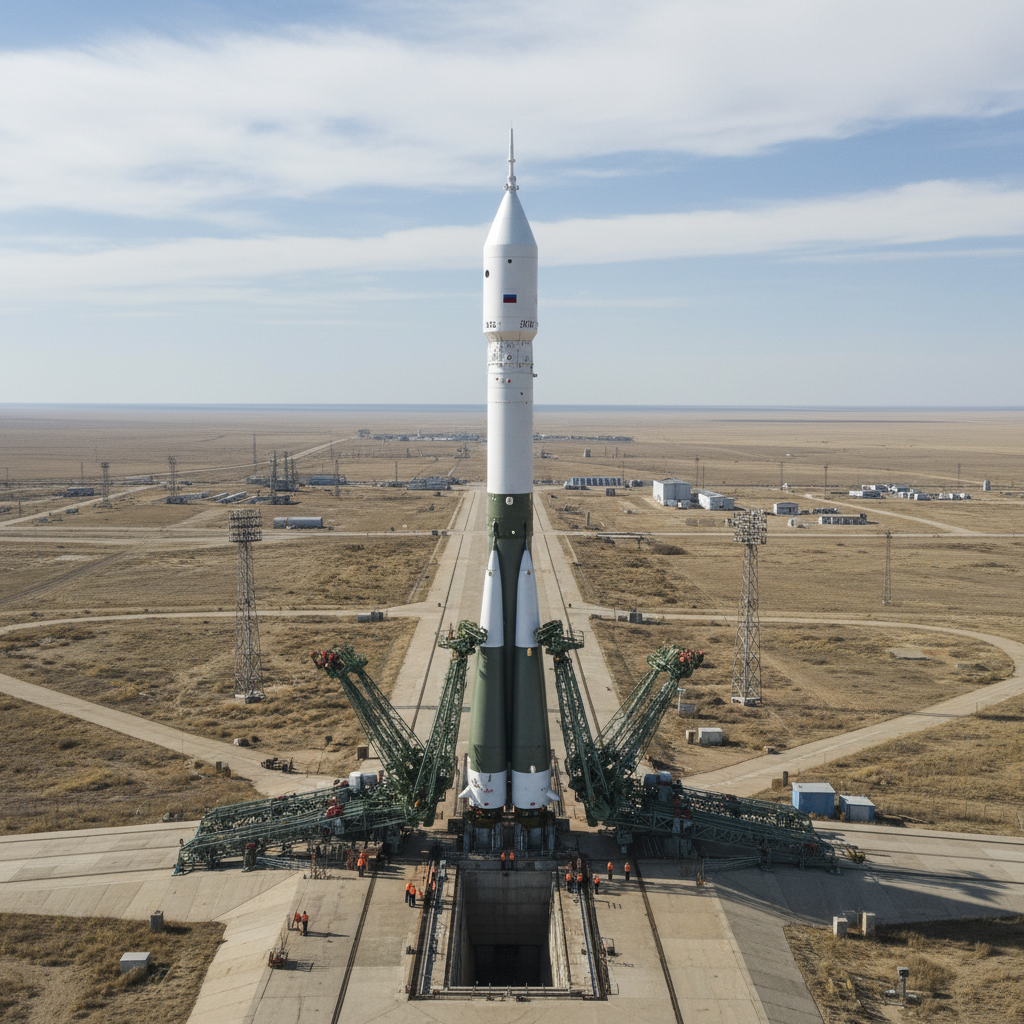
Russia plans to test launch its most modern rocket, the Soyuz-5, before the end of this year. The news was delivered by Dmitry Bakanov, the head of Roscosmos, in an interview to state media agency TASS earlier today.
“Yes, we are planning for December,” Bakanov told TASS, according to a translation of the interview. He added that final preparations for the first liftoff are close to completion. Soyuz-5 will launch from the Baikonur cosmodrome in Kazakhstan. If all goes according to plan, this would be the first test flight of a vehicle that has been in development for more than a decade. Roscosmos is likely to conduct several trial launches before putting the rocket into service, which it does not expect until 2028 at the earliest.
Russia’s new flagship rocket is by no means a radical departure in design. While the name Soyuz has become known for Russia’s three-stage crew and cargo launcher, the Soyuz-5 (codenamed Irtysh) is based on Zenit-2, an older rocket first designed in the 1980s by Ukraine’s Yuzhnoye Design Bureau. Zenit rockets were manufactured in Ukraine, and sourced engines from Russia. In that sense, the Zenit represented one of the last vestiges of Soviet-style cooperation in the aerospace industry between Russia and Ukraine. That relationship has since collapsed in the wake of Russia’s invasion of Ukraine in 2022. By the end of 2023, Russia had even struck the factory in Dnipro where Zenit rockets had once been assembled.
In that context, Soyuz-5 is a slightly larger Zenit with the Ukrainian connection replaced by domestic manufacturing. The redesign should make no difference from a technical standpoint, but it does sever all critical dependencies on foreign components. From Moscow’s perspective, this is a win: It ends years of dependence on a foreign nation, while also doing away with the obsolete Proton-M launcher once and for all.
A Bridge Between Past and Future
Technically, the Soyuz-5 is a medium-lift launch vehicle. The rocket can put about 17 metric tons into low-Earth orbit, a capability which is largely due to marginally larger propellant tanks relative to Zenit. The real star of the show, however, is the RD-171MV engine which powers Soyuz-5’s first stage. This engine is the latest iteration of a design first developed in the 1980s.
The engine was initially built for the Energia rocket, which in turn was developed to launch the Soviet Union’s short-lived space shuttle Buran. The latest variant, the RD-171MV, has one major distinguishing feature: it uses no Ukrainian parts. The engine, which runs on a mixture of kerosene and liquid oxygen, is also notably powerful. With a thrust of about 1.7 million pounds-force, it is three times more powerful than NASA’s Space Shuttle main engine. To date, it is also the most powerful liquid-fueled rocket engine in operation.
And yet, despite this pedigree, Soyuz-5 is an expendable rocket. In that regard, it is starting from behind. Most of its likely competitors, notably SpaceX’s Falcon 9, were built with reusability as a key consideration. This difference between the two systems is crucial, and calls into question whether Soyuz-5 will ever be able to carve out a significant share of the international launch market for itself.
Yet the rocket has an important function for Roscosmos. War and international sanctions have left Russia with limited funding for a brand-new, more sophisticated reusable rocket. The Amur project, known officially as Soyuz-7, was meant to fill that gap. It has been in development for years and is to include a reusable first stage and new methane-fueled engines. Amur could, in time, offer competitive prices comparable to SpaceX. But its development has suffered from repeated delays, with its debut now pushed back to at least 2030.
For now, Soyuz-5 will have to do. The rocket will, at the very least, keep the Russian space program on a development track—even if that track is paved with retro technology. To be sure, Russia’s commercial launch prospects are by no means guaranteed. The global launch industry has evolved significantly in the last decade, and companies like SpaceX or Chinese providers have taken a bite out of the market with cheaper and more flexible launch services. Russia’s Soyuz-2 rockets are still used for crewed flights, while the Angara rocket family takes care of heavier payloads, but neither of these systems has managed to build a foothold in international markets. Whether Soyuz-5 can buck that trend remains to be seen.
Nonetheless, it is worth noting that Roscosmos has managed to bring Soyuz-5 to the launchpad under difficult conditions. A successful flight in December will be a signal that Russia, even under sanctions and a tight budget, is still able to put new hardware on the launchpad.
Soyuz-5 will not usher in a new era of rocket design. For Russia, however, it is both a political and industrial statement: a bridge to its independence from foreign technology and to what comes next—whether that next step is Amur, or another, as-yet-unnamed generation of rockets still on the drawing board.