- calendar_today August 10, 2025
Fire rips through MJT gift shop, exhibits left soot-stained
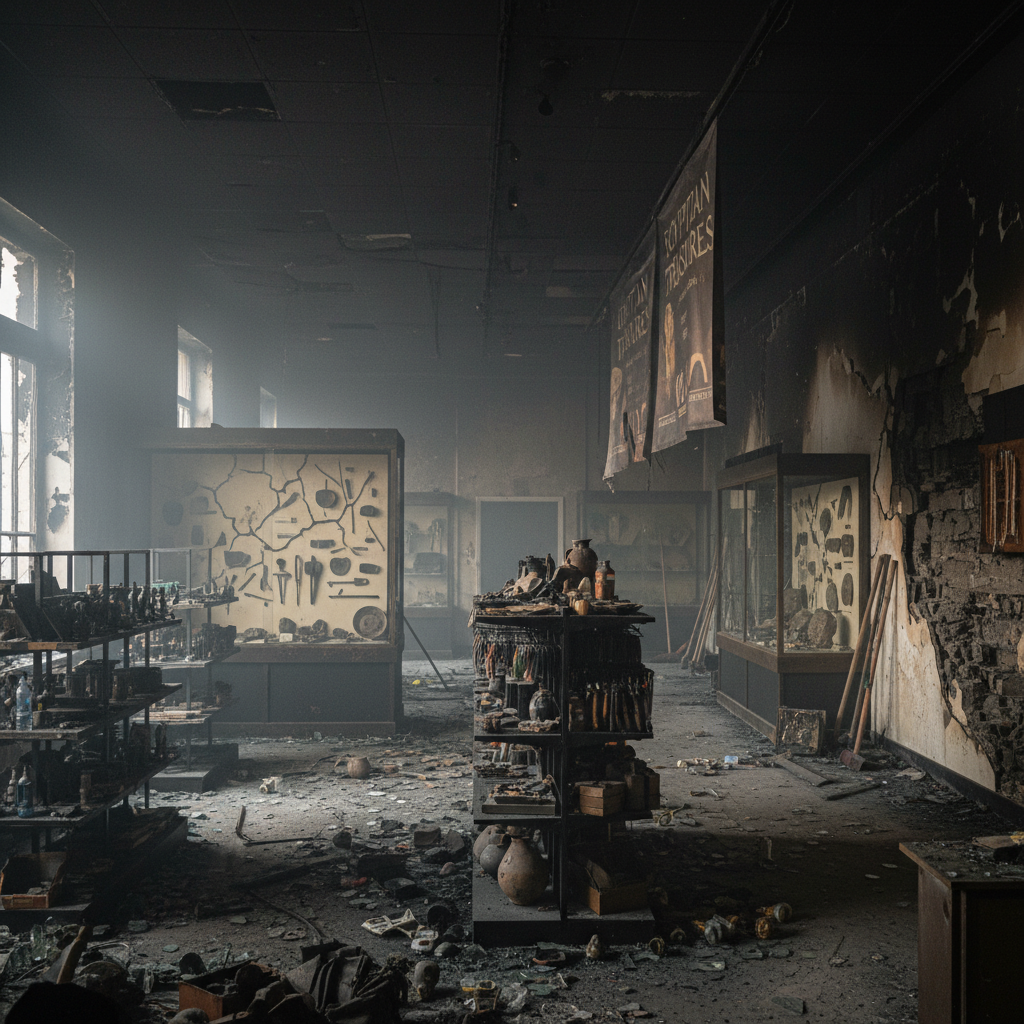
A fire that took place during the early morning hours of July 8 caused significant damage to Los Angeles’ Museum of Jurassic Technology, one of the more eccentric corners of the city’s cultural scene. According to an update to an article on the blaze published earlier this week by LA Weekly, the fire destroyed the museum’s gift shop and also caused widespread smoke damage across the museum’s interior. It’s estimated that the museum, which has been closed since the fire, may lose up to $75,000 in revenue and could reopen next month.
The museum’s physical building is in Culver City, but the Museum of Jurassic Technology has long been a bit of an LA cultural institution unto itself. The MJT was founded in 1988 by David Hildebrand Wilson and Diana Drake Wilson, and has gained a loyal following for its intentionally baffling and often disorienting exhibits. The museum’s description on its website says that it is “dedicated to the advancement of knowledge and the public appreciation of the Lower Jurassic.” However, few of the museum’s exhibits have much to do with the Lower Jurassic, and the museum’s stated goal, too, is more a matter of style than content. The museum has been described as a modern-day incarnation of cabinets of curiosity, or wunderkammers, an early modern analogue to the museums we know today. (In European Renaissance culture, a wunderkammer or kunstkammer, literally a cabinet of wonder or art, was a collection of unusual, rare, or simply interesting curiosities. Wunderkammers were the predecessors to modern museums, and the best-known such collection was assembled by King Rudolf II of the Holy Roman Empire.)
Over time, the MJT has attracted attention for its self-reflexive approach to storytelling and exhibitions, and also for its often uncanny sense of layering reality and fiction. Some of its more enduring exhibits are genuine collections of historical artifacts and objects, such as a tribute to 17th-century natural philosopher Athanasius Kircher, an encyclopedic scholar who died before modern specializations of science and philosophy truly took hold, and the work of Hagop Sandaldjian, an Armenian American artist known for creating hyper-miniature sculptures inside the eye of a needle from materials including human hair. Others are so bizarre or exist in such a gray area between verifiable history and total fabrication that many of the museum’s visitors likely don’t know what to make of them. For instance, the museum once had an exhibit that documented a letter-writing campaign to the Mount Wilson Observatory in the early decades of the 20th century. The “letter writers” were amateur astronomers who were never heard from by the observatory after their initial correspondence. One part of the exhibit, called “The Garden of Eden on Wheels,” visually documents a visit to the trailer parks of Los Angeles and environs.
A number of the museum’s exhibits skew even more wacky. One room holds decomposing dice collected by magician Ricky Jay, while others have “stereographic radiographs” of flowers, microscopic mosaics made from butterfly wing scales, and collections of unopened mail that the director of the museum kept from real and imagined visitors. In 2005, the museum also opened a Russian tea room inside the museum, complete with a replica of Tsar Nicholas II’s study at St. Petersburg’s Winter Palace.
Fire and Damage
In a narrative first published by LA Weekly and which is reprinted in full in Weschler’s piece, writer Lawrence Weschler, who has followed the MJT closely and wrote a book about its history and collections called Mr. Wilson’s Cabinet of Wonder, details what transpired on the night of the fire. The blaze was first noticed by David Wilson, the museum’s founder, who was living in a home that shares a backyard with the museum. Wilson, who was awakened by the sound of the fire, “raced out” to the scene with two fire extinguishers. He “saw a ferocious column of flame shooting out of one of our corners,” Wilson later recalled, “writhing and arcing as it went, and climbing up the corner wall that faces the street.”
Wilson’s fire extinguishers were ultimately not enough to suppress the blaze, however, and it took a second pair of firefighters, Wilson’s daughter and son-in-law, to bring the fire under control. They showed up just moments after Wilson had arrived, with a larger fire extinguisher, and were able to largely quell the flames by the time the Culver City Fire Department arrived at the museum. The firefighters later told Wilson that they probably would not have been able to contain the fire had they been just a minute or two later.
Damage from the fire was ultimately mostly limited to the gift shop, although smoke damage spread across the museum. Wilson’s description of the smoke damage is remarkably evocative: “The next day, I returned, and what I first experienced, on entering, was as if someone had poured a thin creamy brown liquid, evenly, all over—on the walls, the vitrines, the ceiling, the carpets, and eyepieces, everything.” Smoke damage is typically extremely difficult to clean up and presents special challenges in a museum environment, especially one that places as much emphasis on presentation as the MJT. In the week following the fire, the museum’s staff and volunteers have been laboring to clean and restore the affected portions of the museum; that process, according to Weschler, has been slow going.
To that end, Weschler has made a call to those who support the museum to donate directly to its general fund to cover expenses and cleanup efforts. The museum, which Weschler deems “one of the most truly sublime institutions in the country, and a place so strange and improbable, on top of that, that it doesn’t fit our modern grids of category—not science, not art, not narrative,” needs all the support it can get.
The museum has not yet set a date for reopening, but hopes to do so next month, and Weschler and others are optimistic that the museum’s sardonic, scholarly, and surreal magic will be able to shine through the tragedy.