- calendar_today August 14, 2025
.
Buyer enthusiasm for electric vehicles is waning in the United States, leading to adoption uncertainty. After recording month-on-month growth for more than a year, EV sales are now in contraction. Automakers from Genesis to Volvo have experienced customer resistance to their electric lineups, with both companies deciding to review their offerings as a result.
Political headwinds are also making buyers more skittish. The Biden administration has already eliminated EV subsidies and is also rolling back vehicle pollution standards. Buyers now have fewer federal incentives than before, but according to industry analysts, the biggest headwind for EV adoption in the US may already be on hand.
Garages, Get Ready
Charging has long been the most-cited factor behind consumers’ reluctance to buy electric cars. In a new analysis, Telemetry Vice President Sam Abuelsamid further breaks down the EV charging challenge by drilling into one of the more understated aspects: the use of a homeowner’s garage.
Fast charging may grab all the headlines, but the majority of electric charging will continue to take place at home. An estimated 80 percent of all EV charging is done with AC power, the majority of which happens at a single-family residence. In fact, an analysis from the National Renewable Energy Laboratory (NREL) found that 42 percent of Americans who own a home are already able to plug their EV in at home, with a garage outlet capable of level 2 (240-volt) charging.
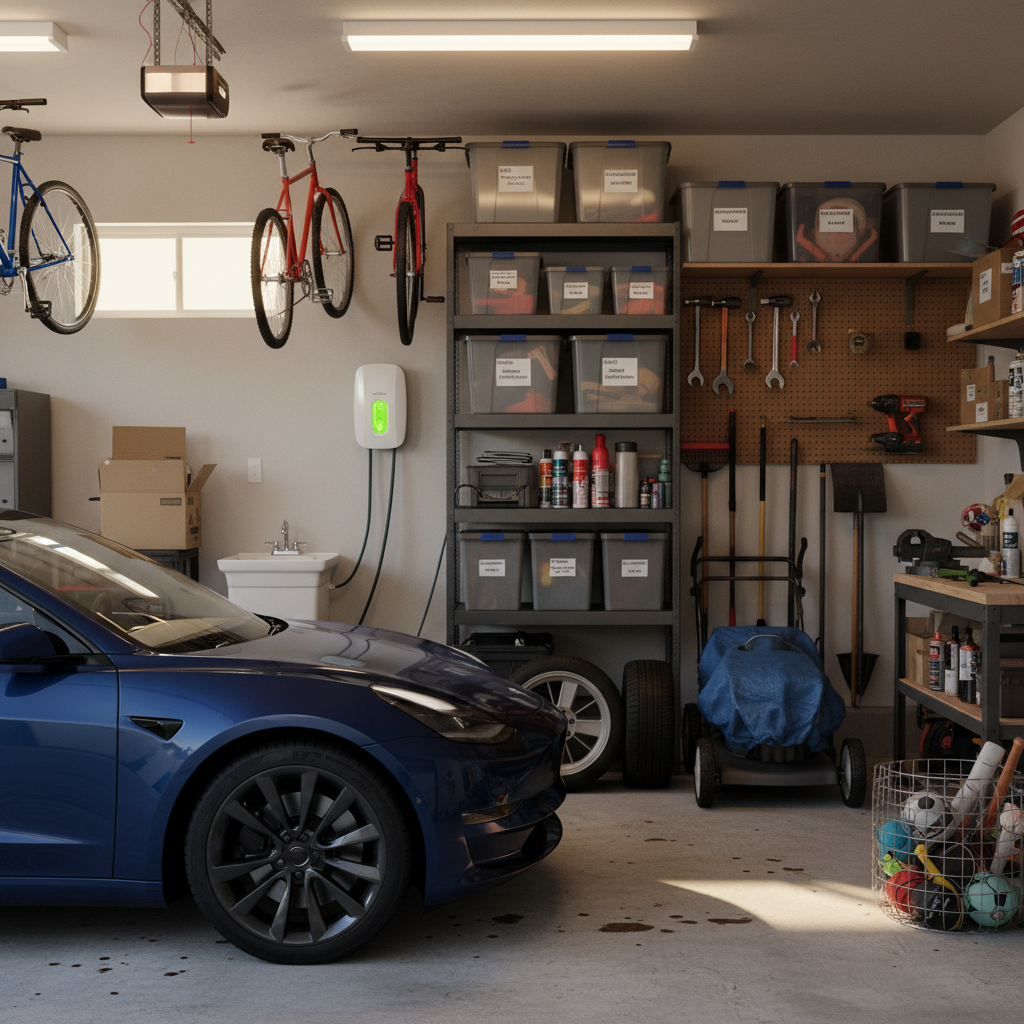
This number could rise significantly to 68 percent, if homeowners simply cleared some space in their garages and altered their parking habits. “90 percent of all houses can add a 240 V outlet near where cars could be parked,” Abuelsamid points out. “Parking behavior, namely whether homeowners use a private garage for parking or storage, will likely become a key factor in EV adoption.”
If more Americans parked their vehicles in their garages instead of using them as storage closets, the number of homes with EV charging potential would jump from 31 million to over 50 million. Factor in the number of homes where wiring a new outlet is a possibility and that number jumps to over 72 million. That number is already well beyond even Telemetry’s most bullish projections for EV market penetration in 2035, which calls for between 33 million and 57 million electric vehicles in the US.
These numbers, however, don’t necessarily reflect the actual number of EV-ready homes in the country. That same NREL study found that nearly 34 million homes would need an electrical upgrade to support a level 2 charger, which requires at least 30 amps of power. This could mean the difference between wiring a new outlet and having to replace the whole electrical panel. These upgrades can cost thousands of dollars.
The risk of these additional costs comes on the back of one of the key selling points of electric cars: lower long-term cost of ownership. When added to the purchase price, the cost of installation can bring the total cost of ownership to rival, if not surpass, that of a comparable gas-powered car.
Things get even tougher for the 23 percent of Americans who live in multifamily housing, which covers anything from apartments to condos to townhomes. For these individuals, the choice of charger installation is rarely, if ever, in their own hands. Accessing an outlet usually requires either the permission of a landlord, management company, or co-op board, and gaining that approval is no guarantee.
The additional financial barrier is also greater. For example, a co-op may need a complete electrical panel upgrade to first host a pair of shared level 2 chargers, a job that can cost millions of dollars to execute. Wiring will have to be run to far-flung parking spots, further adding to the costs. Apartment, condo, and townhouse residents are also generally not eligible for municipal or utility programs that help defray the costs of charger installation.
As of now, some one million EV owners in the US live in multifamily housing, but just 11 percent of those have parking spots close enough to an outlet to plug their car in and charge. In an effort to catch up, some states are mandating that between 20 and 25 percent of parking spaces in new developments be EV-ready. In total, Telemetry forecasts between 6.7 million and 11.4 million charging-capable spaces in multifamily dwellings by 2035. That’s short of the projected market need, even with these mandates.
Building out a reliable public charging network will be crucial. Telemetry estimates that 11.7 million to 14.3 million EV owners who own a home, and 7.8 million to 8.1 million EV owners who live in multifamily residences will depend on public charging by 2035.
Satisfying this demand will require 523,000 to 586,000 DC fast chargers, and another 1.5 million to 1.6 million level 2 chargers nationwide. Scaling this infrastructure, however, is not without its own challenges. The power companies are already under stress, with new AI data centers vying for generation and distribution capacity, complicating the rollout of large-scale charging sites.
EV Charging: Hitting a Ceiling?
EVs are typically sold as a straightforward climate-positive, cost-effective alternative to gas-powered cars. Yet, the road to full adoption in the US is less direct than it may seem. While millions of homes already have the capacity to charge EVs, garage clutter, high electrical upgrade costs, and the struggles of multifamily living present real barriers to adoption. Even as public charging infrastructure expands, demand may outstrip supply over the coming decade.
One thing, however, is certain. As the US attempts to transition to electric vehicles, the fate of the market may well rest on how clean homeowners are willing to keep their garages.