- calendar_today August 12, 2025
.
Washington and New Delhi had for many years what was often described as one of the strongest and most productive strategic partnerships of the post–Cold War period. That’s now in danger of unravelling as trust is lost between the two sides on a host of issues from tariffs to oil buying and the relationship with Beijing.
“I think we’re in a situation in the U.S.-India relationship where the premises and assumptions of the last 25 years, that everybody worked very hard to build, including the president in his first term, have just come completely unraveled. The trust is gone,” Evan Feigenbaum, a South Asia expert at the Carnegie Endowment for International Peace, told reporters.
The U.S. is now set to double tariffs on most imports from India on August 27, and the move has already sent New Delhi scrambling east. The tariff hike was first set at 25 percent on June 16 in retaliation for India’s refusal to cut oil imports from Russia over the war in Ukraine.
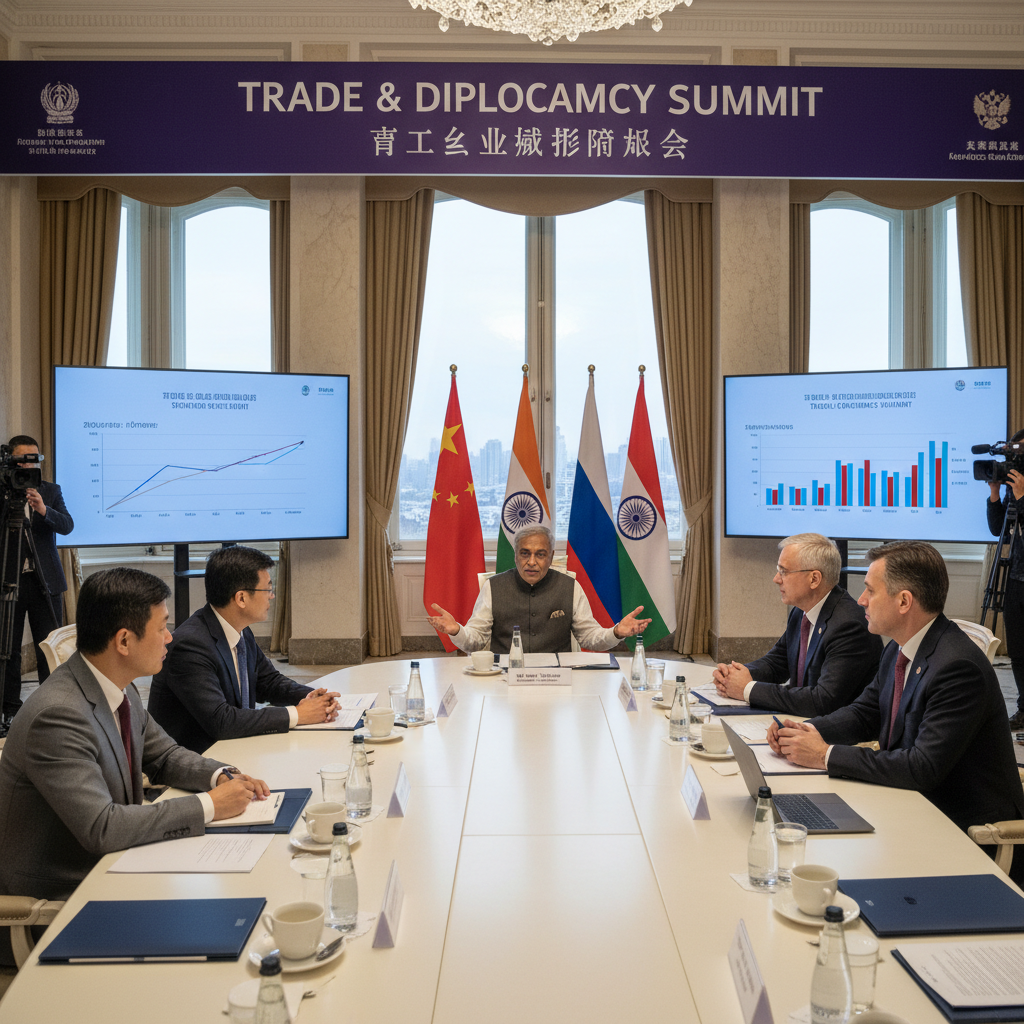
In response, New Delhi has grown closer to Russia — and even China. India’s national security adviser visited Moscow last week; Foreign Minister Subrahmanyam Jaishankar has held high-level talks there as well; and Chinese Foreign Minister Wang Yi just wrapped up a visit to New Delhi. Modi is expected to make his first visit to China in more than seven years later this year, and Russian President Vladimir Putin is also likely to receive the Indian prime minister in Moscow before the end of 2023, and experts say it’s not just for optics.
“I think what we’re also seeing is that Indian public opinion has hardened, and they’re signaling very clearly that they view that as interference in India’s foreign policy, and they are not going to put up with it,” Feigenbaum said.
India’s state-run refiners had paused Russian oil imports during the early weeks of the Ukraine war, but they’ve now resumed them in large part due to discounts Moscow is providing on the discounted barrels. In the first half of this year, Indian public refiners bought Russian oil at discounts ranging between six and seven percent. Russia has continued to offer new supplies, including Deputy Prime Minister Denis Manturov, who said Moscow “will continue to supply crude, oil products, thermal and coking coal, while also seeing potential for the export of Russian LNG.”
Tariffs are a Symptom of Wider Breakdown
Michael Kugelman, a South Asia analyst at the Wilson Center in Washington, added that tariffs are not the only reason that New Delhi has tried to dial back its rhetoric on Moscow. “We’ve seen indications for almost a year of India wanting to ease tensions with China and strengthen relations, mainly for economic reasons. But the Trump administration’s policies have made India want to move even more quickly,” he said.
Feigenbaum said that while New Delhi’s overtures to Moscow may at first appear to be performative to a certain degree, in many areas — especially defense and the economy — India is doubling down on its ties with Russia, and that won’t change. “India is going to double down on some aspects of its economic and defense relationship with Russia — and those parts are not performative,” he said.
India has long been diversifying away from Russian weapons, particularly after its military reforms in 2001. It has been inking defense contracts with the U.S., France, and Israel as well. “Energy is the area in which the Russian connection is deepening the most. This is something that they were talking about before the war, but have followed through on in a way that India-Russia defense hasn’t,” Kugelman added.
Russia now accounts for 35 percent of India’s crude oil imports this year, compared to 0.2 percent in 2021, before the war in Ukraine. The Russian purchases have bought Modi political capital at home as he has presented himself as someone who will stand up for India’s sovereignty and stand by his decisions — particularly the ones that he says are made to protect the livelihoods of the country’s farmers, small business owners, and young job seekers. (Those areas are Modi’s domestic political sweet spots.) India had already made a number of concessions to Washington before the tariff hike, such as the reduction of tariffs and repatriation of some Indian workers. “Because of those concessions, India needs to be careful about signaling further willingness to bend. This is one reason there was no trade deal — Modi put his foot down,” Kugelman said.
Criticism from Trump Allies
Navarro, who was a White House trade adviser in Trump’s administration, criticized New Delhi’s oil imports from Russia in an op-ed in the Financial Times, saying that India had been opportunistic and had tried to secure Russian oil at a “huge discount,” and its purchases “are deeply corrosive to U.S. objectives in Ukraine.” He argued that Washington should have imposed the tariffs on India “years ago” and that doing so now would hurt the country “where it hurts — its access to U.S. markets — even as it seeks to cut off the financial lifeline it has extended to Russia’s war effort.”
The rupture in U.S.-India relations is particularly stark in the historical context. In 2008, the two sides set an important marker with the signing of the U.S.-India civil nuclear deal. The deal granted India access to American fuel and technology even as it has refused to sign the Non-Proliferation Treaty, or NPT. But then the two sides were still able to compartmentalize the differences that they had and ensure that those differences didn’t become more pronounced.