- calendar_today August 17, 2025
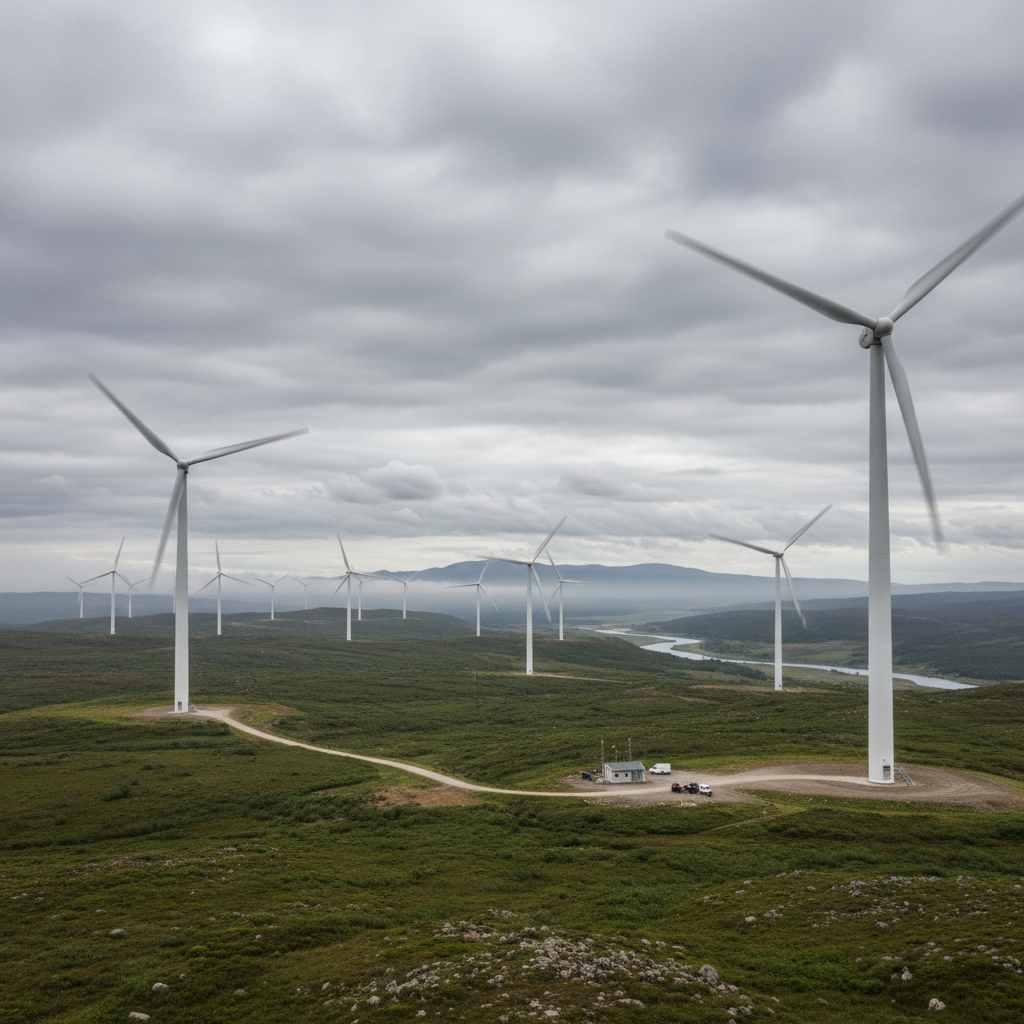
President Donald Trump likes to talk about wind turbines as if they are his main policy concern. A few days ago, on the cusp of a press conference to unveil an EU trade deal, he used the appearance to question the industry again. “Wind turbines, or windmills, they’re a con job,” he said. “They make the whales loco. They kill all the birds. They’re a disaster, in terms of everything.”
On the surface, Trump’s comments are just one more example of his showmanship and tendency to reframe official press events with his pet conspiracy theories. This time, he is throwing his weight against renewable energy, whose adoption he has consistently resisted at every opportunity.
A look at how Trump frames wind turbines suggests there is more going on. The former President calls them “windmills,” and his broadside this week followed a speech at the United Nations this month, with similar attacks.
Dig a little deeper, and you will find this isn’t an American problem. Climate scientists and social psychologists have found that for a significant number of people, resistance to renewable energy isn’t just about specific technologies or policies—it is driven by deep-seated conspiracy beliefs.
Trump’s rhetoric might not seem a useful model, but his words are drawing on some common themes. “Windmill” itself is something of a late-stage climate denier’s euphemism. As well as the generic association of “mills” with quaint old technology, the term “windmill” also evokes 17th-century windmills that ground grain, often described as hand mills. Trump is using history to associate modern wind turbines with images of bucolic European history.
People’s visceral responses to such issues point to another early industrial revolution technology that caused similarly mixed responses. In 1878, a San Francisco priest named John Diniz cited telephones in the pulpit as the work of Satan, for their ability to “scatter disease with fearful celerity among the inhabitants of a densely populated district.” That same year, the Reverend Alfred Barry of London’s St Paul’s Cathedral compared the telephone to a giant spider, predicting that “the enemy of our race will crawl under our very beds.”
Weirdly, in each case, there was some truth to their criticisms. In both the United Kingdom and the United States, new phone lines were sometimes sited over sewer vents or drains, causing the smallpox epidemics that terrified Diniz and Barry. But neither minister understood the nature of smallpox. What made their anxieties sticky was the technological disruption, a visceral fear of new wires crisscrossing the landscape, transforming the way people live and work.
The Emergence of Anti-Wind Conspiracy Theories
Science has understood the role of carbon dioxide emissions in climate change since at least the 1950s, and there has always been an understanding that this would eventually lead to profound and relatively rapid environmental change.
But despite that advance, the early push for renewables was framed as a geopolitical and economic contest, rather than a climate measure. Fossil fuel companies were established players, with both the power and the interest to slow the transition.
The Simpsons episode “Burns, Not-Shrubbing” features a satire of such thinking. The coal tycoon Mr Burns builds a tower to the sun to cause a blackout in the neighboring town of Springfield, forcing the residents to buy his nuclear power.
The cartoon skit was an exaggeration, but the anxieties weren’t: The fossil fuel sector has worked aggressively to downplay renewables, including efforts by the former Australian prime minister John Howard. In 2004, Howard convened a group of fossil fuel lobbyists called the Low Emissions Technology Advisory Group, who were tasked with identifying ways to slow the growth of renewable energy in Australia, to maintain coal, oil, and gas dominance.
As early as 2001, wind farms themselves were under attack. In Australia, the skeptics focused on what they saw as the visual intrusiveness of the turbines, a backlash often rooted in either misinformation or science denial. Wind turbine syndrome, a “non-disease” according to one doctor, was the chief bogeyman.
In reality, opposition to wind farms appears to be driven less by demographic variables than by conspiratorial thinking. In one early study, Kevin Winter and colleagues surveyed 848 Germans about wind farms. They found that demographic factors like age, gender, and education were “rather weak predictors” of opposition. Conspiracy thinking, by contrast, was a very strong predictor.
Winter and his team followed up their original 2010 study with a second. It was published in 2017 and focused on the United States, the United Kingdom, and Australia. They found that people who believed in conspiracy theories were more likely to be anti-wind, regardless of their political affiliation or geographic location. Some respondents worried about the climate denial implications of wind power, while others focused on whether wind turbines were a “Trojan horse” for government control or energy insecurity. “In all three countries, believing in conspiracy theories appears to be an important aspect of wind energy opposition,” they wrote.
Critics and climate deniers use wind farms as convenient distractions, while the more persistent opposition is caused by the culture wars and anxiety over political change.
The Impact of Anti-Renewables Conspiracy Theories
The presence of renewable energy infrastructure has become part of a war of cultures, between those who see a clear and present need for climate action and those who feel threatened by the pace of change.
Wind farms present a clear example. Supporters see them as an emblem of progress and modernity; detractors see them as a tool of government overreach and loss of control.