- calendar_today August 7, 2025
.
Ukrainian President Volodymyr Zelenskyy said on Monday that he had a “good” conversation with U.S. President Donald Trump on the issue of security guarantees for Ukraine as the Russia war moves into its fourth year.
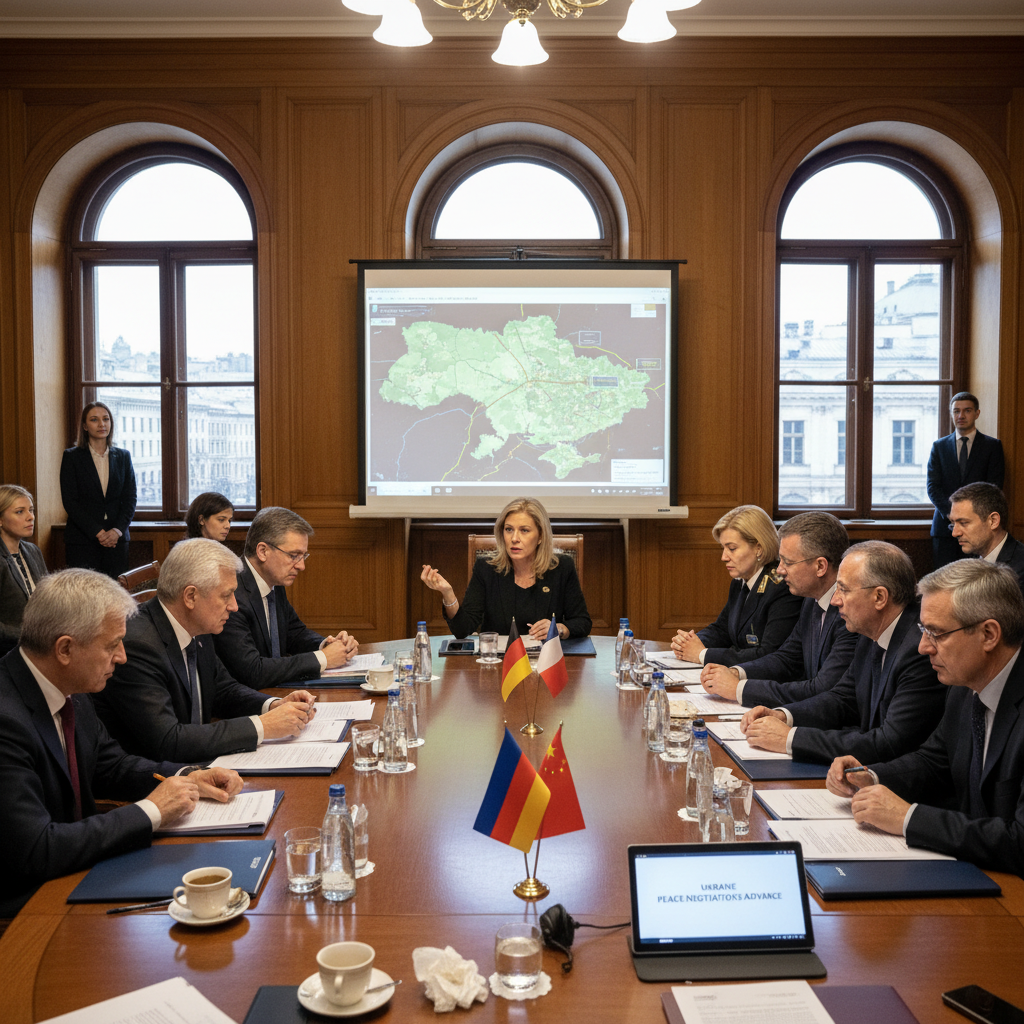
In a joint statement with Trump at the White House alongside European leaders, Zelenskyy said security guarantees were at the heart of Ukraine’s survival and future independence. “The first one is security guarantees. And we are very happy with President [Trump], that all the leaders are here, and security in Ukraine depends on the United States and European countries,” Zelenskyy said. He also added that Washington’s readiness to extend strong signals of support was “very important,” though he did not elaborate on what such guarantees would look like.
Trump highlighted the importance of security but put most of the responsibility on Europe, while also reiterating that a conflict cannot be solved without hard discussions about territory. “We’re going to help them, and we’re going to make it very secure,” Trump said. “We also need to discuss the possible exchanges of territory, taking into consideration the current line of contact. That means the war zone, the war line center.”
U.S. and European Leaders Divided Over War in Ukraine
The White House meeting on security highlighted the sharp divisions among Western leaders over how best to balance supporting Ukraine and pressing for a negotiated peace. Trump has repeatedly held out the possibility of territorial concessions, while Zelenskyy has forcefully argued for Ukraine’s sovereignty and international borders to be respected at all costs.
On the Hill, U.S. lawmakers sharpened calls for economic pressure against Russia and its trading partners. Senator Lindsey Graham, R-S.C., said in an interview that the Trump administration needs to be more aggressive in trying to cut off Moscow’s finances by going after countries that are still buying Russian oil. The senator is also co-sponsoring a bill that would authorize the president to impose tariffs of up to 500 percent on states that continue to do business with Russia.
“My advice to President Trump and [Secretary of State Marco Rubio] is, you’ve got to convince Putin that if this war doesn’t end justly and honorably with Ukraine making concessions also, we’re going to destroy the Russian economy,” Graham told Fox News. The senator, who has been a vocal backer of the Republicans’ foreign policy on Ukraine, added that China, in particular, is one of the only states in a position to end the war. “The second most important person on the planet to end this war is President Xi in China,” Graham said, calling on Washington to lean on Beijing to withdraw support.
Trump has already shown that he’s willing to use tariffs as a cudgel against other states. In August, the U.S. president announced a 50 percent tariff on India, in part over its purchase of Russian oil. Graham suggested that the same sort of action against China, if threatened, could change the trajectory of the conflict very quickly.
In Europe, the EU is working on its 19th round of sanctions against Moscow that will target areas including Russia’s energy revenues, banking access, and military-industrial base, while also plugging some loopholes that have enabled companies and countries to evade measures. The new EU sanctions package could be finalized later this month.
After nearly four years of coordinated Western sanctions, Russia is now the most sanctioned state in modern history—overtaking Iran, North Korea, and Venezuela in terms of economic isolation.
Sanctions and Ceasefire
Sanctions, however, are not the only contentious topic. European leaders are also pressing Trump on the importance of a ceasefire before meaningful negotiations can begin. German Chancellor Friedrich Merz argued that a temporary truce was needed to give talks credibility. “I can’t imagine that the next meeting would take place without a ceasefire,” Merz said. Trump strongly disagreed, countering that the six peace agreements he has made in the last few months were signed without a ceasefire. “You have a ceasefire, and they rebuild and rebuild and rebuild,” Trump said. He did concede that the main benefit of a truce would be an end to the war’s civilian casualties.
Finnish President Alexander Stubb also attended the White House talks. Stubb, who took office in March 2024, has expressed open skepticism about Russian President Vladimir Putin’s ability to observe a ceasefire, should one be agreed. In his remarks, Stubb also emphasized his country’s history with Russia and the length of the border, stretching more than 800 miles. “If I look at the silver lining of where we stand right now, we found a solution in 1944, and I’m sure that we’ll be able to find a solution in 2025 to end Russia’s war of aggression,” Stubb said, who is believed to be one of Trump’s closest European interlocutors.
In addition to sanctions and ceasefires, Trump has been explicit about his demands for peace. In a post on Truth Social, the former president urged Ukraine to formally give up Crimea, which Russia seized in 2014, and to give up its NATO aspirations. “President Zelenskyy of Ukraine can end the war with Russia almost immediately, if he wants to, or he can continue to fight,” Trump wrote. He blamed former President Barack Obama for “giving” Crimea to Putin without any resistance more than a decade ago, and also said that “NO GOING INTO NATO BY UKRAINE” is a bright red line.
Zelenskyy’s demand for long-term Western guarantees for Ukraine and Trump’s calls for concessions on key issues put the deep divides in Washington and Europe on full display. How best to end the war remains in question with new sanctions on the way, tariff threats on the horizon, and battlefield clashes continuing almost daily.