
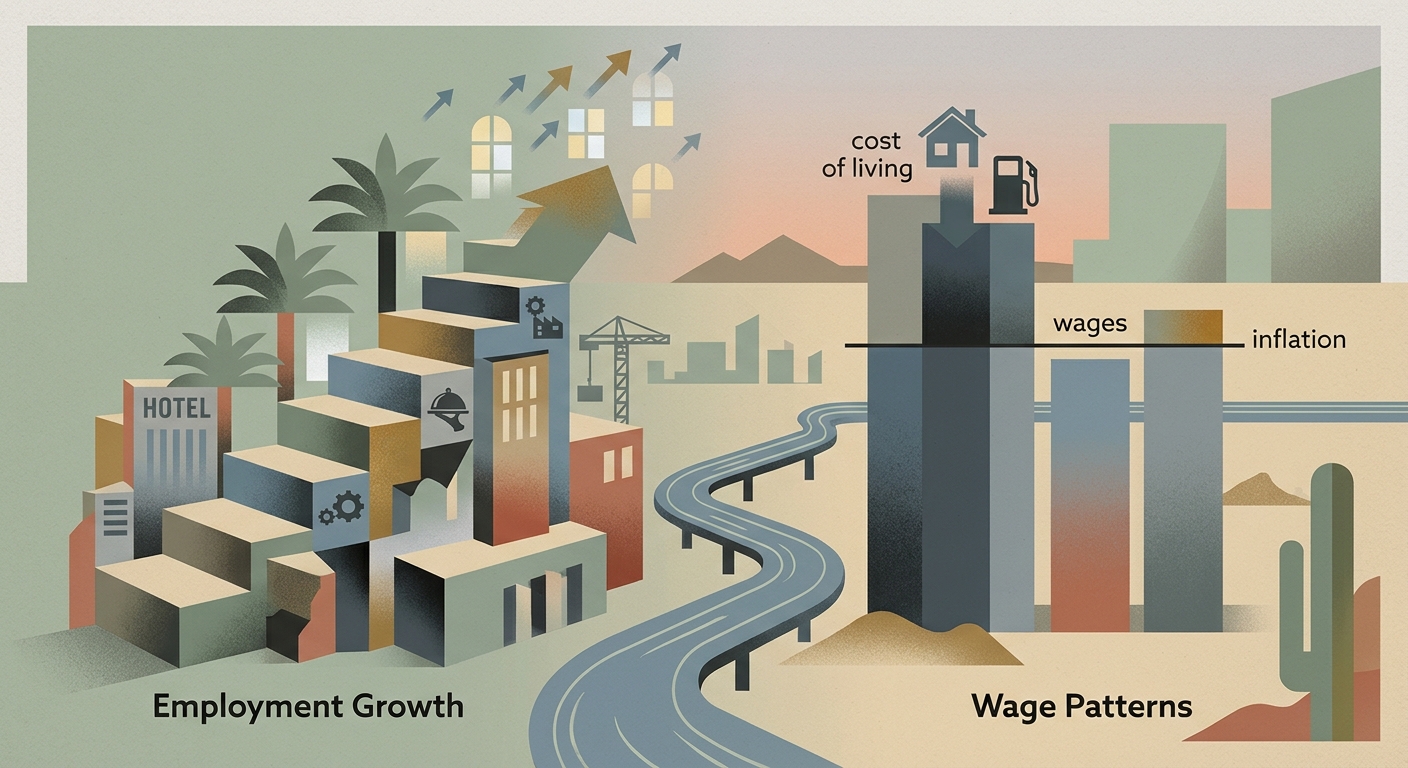
AI-generated illustration; not a photograph of the reported event.
- calendar_today November 2, 2026
The Las Vegas-Henderson-North Las Vegas metropolitan area continues to be a significant hub of economic activity in Nevada, with recent official data providing a comprehensive view of employment levels and wage patterns across industries.
As of the latest available period ending September 2026, the U.S. Bureau of Labor Statistics reports that the metro area's civilian labor force was approximately 1,226,200 persons. Of these, about 1,166,900 were employed, with an unemployment rate of 4.8%. The total number of nonfarm wage and salary jobs also reached 1,190,500, marking a 1.7% increase from the same period a year prior.
Detailed figures show that leisure and hospitality remains the area’s largest employment sector, accounting for 302,800 positions in September 2026. Trade, transportation, and utilities provided 210,000 jobs, while professional and business services posted 186,600. Education and health services contributed 143,200 jobs; government employment reached 123,800. Sectors such as construction (82,700), manufacturing (31,100), and information (15,900) continue to represent smaller but stable portions of the local job market. Changes over the past year varied by sector, with professional and business services (+6.3%) and education and health services (+5.1%) experiencing robust growth, while financial activities recorded a decline of -2.1%.
While broad wage statistics for Las Vegas across all sectors are not detailed in the most recent summary tables, data for specific occupations are available. For example, postsecondary computer science teachers in Nevada—reflecting a higher-wage occupation—earned an annual mean wage of $132,770 as of May 2023, a figure that ranks the state among the nation’s highest for this occupation. (Bureau of Labor Statistics, May 2023)
For more granular insights on occupational wages and sector-specific compensation, stakeholders are encouraged to consult resources such as the Occupational Employment and Wage Statistics (OEWS) and the Quarterly Census of Employment and Wages, which provide detailed breakdowns for the Las Vegas-Henderson-North Las Vegas metro area.
Overall, Las Vegas’s recent employment trends show steady labor force participation and growth in most major sectors, underpinned by its traditional strengths in hospitality, business services, and healthcare. Wage data suggest continued opportunities, particularly for high-skill roles in education and technology.


