
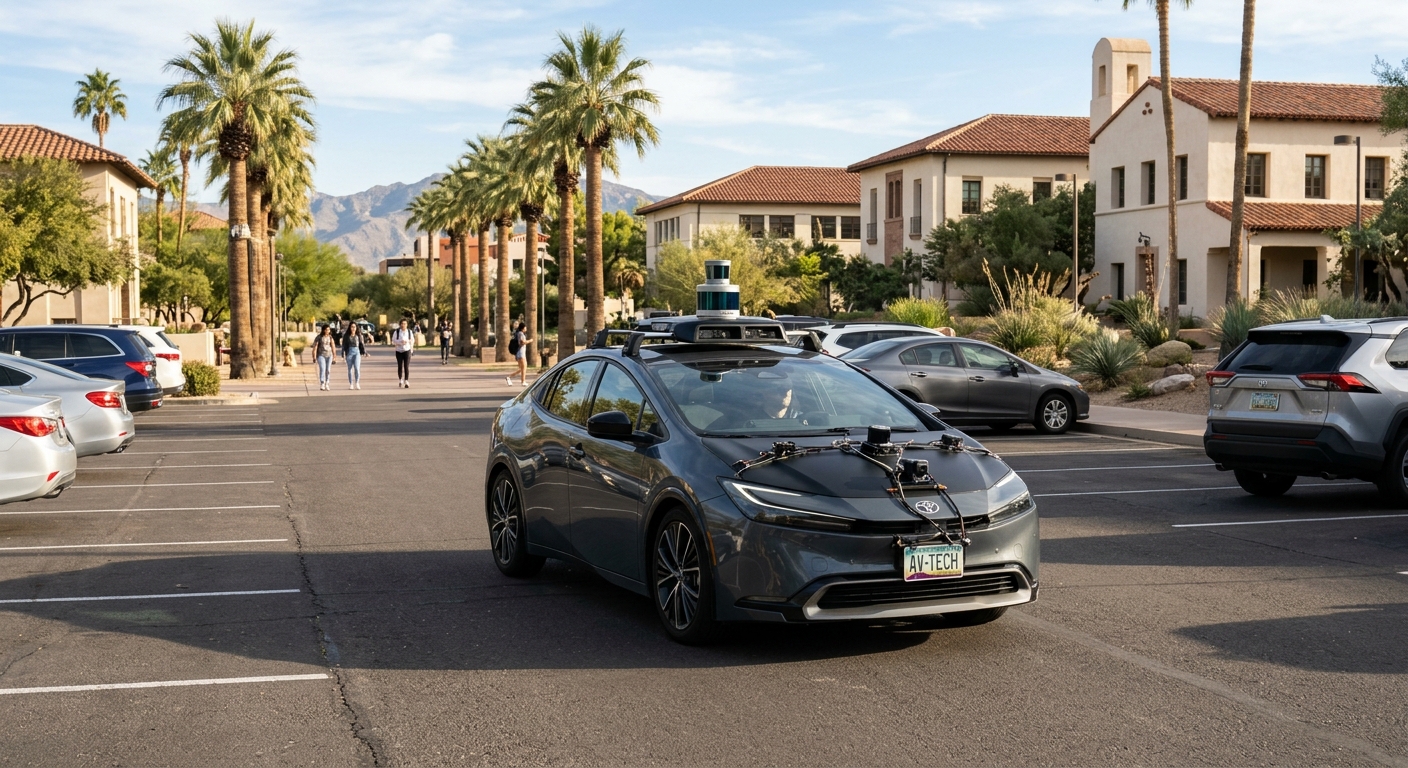
AI-generated illustration; not a photograph of the reported event.
- calendar_today November 28, 2026
UNLV Lab Develops Self-Driving Car to Explore Autonomous Vehicle Technology
At the University of Nevada, Las Vegas (UNLV), innovation in autonomous vehicle technology is accelerating at the Real Time Intelligent Systems Laboratory (RTIS Lab), located in the Thomas T. Beam Engineering Complex. Under the direction of associate professor Brendan Morris, the lab has spent five years transforming a standard 2018 Lincoln MKZ sedan into a functioning self-driving car, providing valuable research and educational opportunities for students interested in this evolving industry.
Equipping the Vehicle for Autonomy
The RTIS Lab’s test vehicle is outfitted with a sophisticated array of computer monitors and a pyramid-like structure housing multiple cameras mounted on the hood, alongside a light detection and ranging (LiDAR) system. This advanced electronics setup, with custom systems even in the trunk, enables the car to perceive and interact with its environment in real-time, forming the foundation for ongoing research into computer vision and artificial intelligence (AI).
How Computer Vision and LiDAR Enable Navigation
To enable self-driving, the lab’s sedan utilizes a combination of pre-made and real-time maps. The LiDAR system and AI-driven cameras work together to scan and build detailed maps of the car's route, which currently covers a quarter-mile loop between two UNLV parking lots. As the vehicle moves, its sensors continually update its understanding of the environment, allowing it to detect and react to obstacles such as other vehicles and pedestrians. Brendan Morris describes this process as continually collecting data and combining it into an increasingly accurate and comprehensive map.
Student Involvement and Research Goals
Graduate research assistants, including Carlos Funes, play an active role in both the installation and monitoring of the test vehicle’s systems. Using a simulator that integrates real-world data from the car, students can study advanced concepts in machine learning, computer vision, and intelligent systems. The lab is dedicated not only to perfecting autonomous car technology for real-world use but also to exploring how similar methods can help people navigate the world via AI-enhanced cameras and systems.
Exploring the Limits and Applications of AI in Vehicles
The RTIS Lab’s ongoing work showcases the practical applications of computer vision and machine learning outside of conventional autonomous driving. Brendan Morris highlights the broad applicability of these technologies, noting their potential to transform transportation and many other fields where machine learning and real-time data processing are essential.
Looking Forward
As autonomous cars become a more common sight in cities like Las Vegas, the research underway at UNLV signals important steps toward improving autonomous vehicle technology. Through continued hands-on experimentation and data-driven study, the RTIS Lab aims to push the boundaries of what autonomous vehicles can achieve—setting the stage for future innovations in artificial intelligence, vehicle navigation, and intelligent systems.
Source: reviewjournal.com.


